Fleetwood sits at the end of a line, a seaside town in Lancashire with three GP practices serving around 28,500 people. The usual services are all there. But the community’s health isn’t. A quarter of adults live with anxiety or depression, more than twice the England average. Young people are twice as likely to be out of work as elsewhere in the county.
For years, the services designed to help worked separately. A clinic for the body. A different door for the mind. Another for housing, another for work. So a patient was treated for their anxiety while the causes went untouched. Each service handled one part of a person. Nobody looked after the whole.
One GP tried something different
Instead of scaling up the usual clinical response, a local GP built support around the whole person and the community they lived in. A young person’s mental health support might still include therapy, but it’s woven into a community-owned youth centre. The local hospital is community-owned too. Nobody gets passed from ‘health’ to ‘community’. Support already includes both.
The results were striking. Within two years, A&E attendances among children with mental health needs fell by 59%. In one of Fleetwood’s poorest neighbourhoods, antisocial behaviour dropped by 67%.
Fleetwood is not a one-off. It is one bright spot in a much wider field, and a new report we funded, Towards a Relational State, sets out to map it. Marc Le Chevallier, Nigel Ball and Polly Mackenzie at Zinc Innovation Partners wrote it, drawing on a review of evidence and interviews with the practitioners and academics who built the approach it maps, among them Donna Hall, who led the Wigan Deal, and Professor Toby Lowe, who studies why public services struggle with complex problems.
Why services lose the person
The report names something many practitioners already feel in their bones. Relationships are one of the main ways change happens in people’s lives. Yet most public services leave little room for them. Standardised processes and performance targets give consistency and hold services to account, and those things matter. Applied too rigidly, they leave no room for the continuity, judgement and trust that hard problems actually need.
Lowe puts the cost plainly. A support worker sits across from someone whose life is unravelling, but the worker has targets to hit. So they deal with the parts that fit the form: the housing referral, the benefits check. The fear underneath, and the reasons for it, don’t fit anywhere. They become someone else’s problem.
The problems the state most struggles with do not fit that frame. Chronic illness, long-term unemployment, family breakdown, loneliness. They have tangled roots, they cross every service boundary, and they change over time. A fixed process can’t hold a problem that keeps moving.
The report calls the alternative Relational Public Services, and it rests on a simple idea. The relationship between a worker and the person they’re helping is not a nice extra. Take it out, and the rest stops working.
The same idea, in different places
Fleetwood is one example. There are others. Shared Lives matches an adult who needs support with a carer who shares their home and community with them. The Care Quality Commission rates 96% of its schemes good or outstanding, the highest of any regulated social care service. For someone with a learning disability, Shared Lives saves the local authority around £30,000 a year compared with a residential placement. Shared Lives changes who provides care. Wigan Council changed how its staff work, spending years helping them hold different conversations with residents, ones that start with what matters to a person rather than which form they need to fill in.
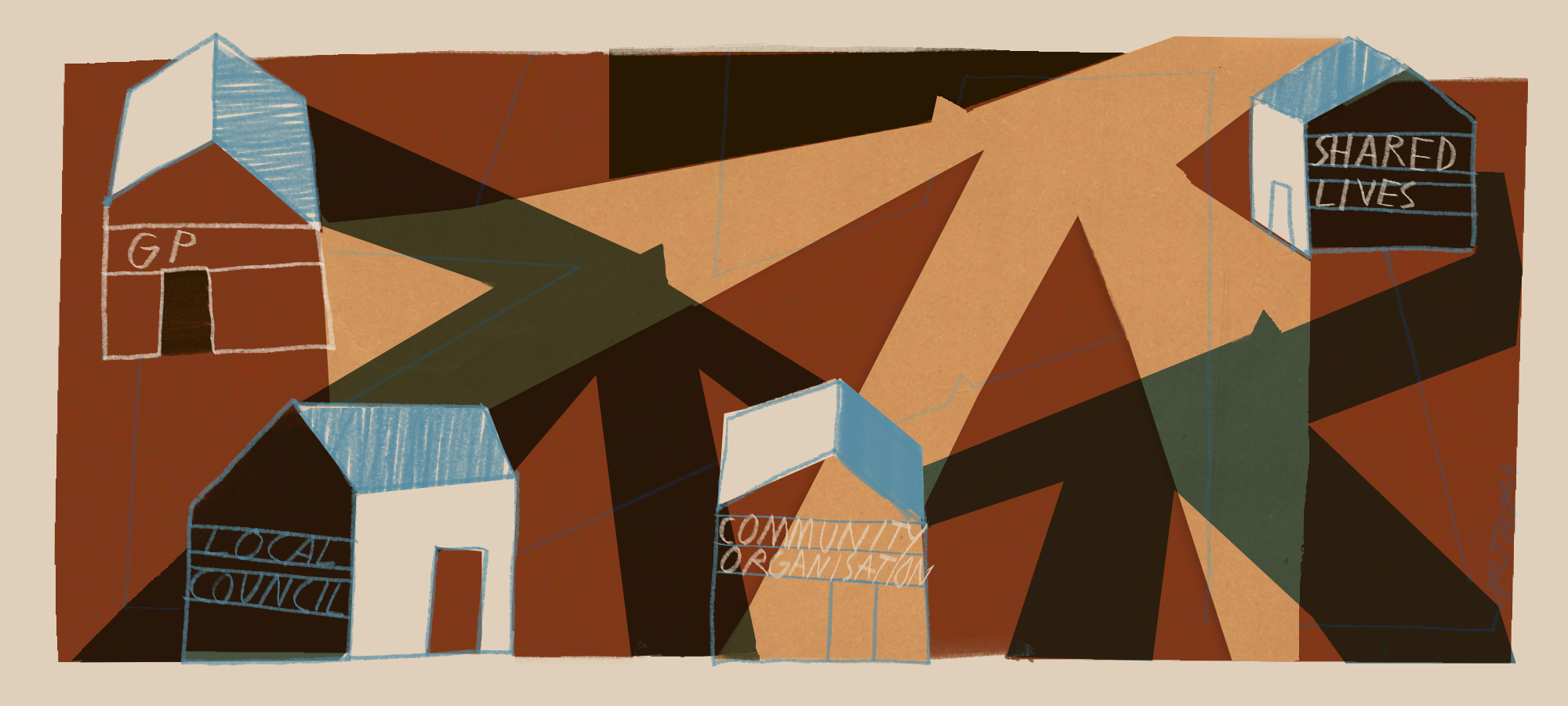
These aren’t three isolated experiments. They’re the same idea in different places: start with the person, not the process. A GP in Fleetwood, carers in Shared Lives homes, staff across Wigan. But they mostly don’t know about each other, and that disconnection is the report’s central finding. Each bright spot stays a bright spot. There’s no shared way to gather what everyone is learning, connect the people doing it, or join up the story for those who decide how public money is spent.
Where a funder might come in
The solutions already work. What they lack is connection. The task is to connect them, strengthen the evidence behind them, and give them enough visibility to spread. Outward, to the many organisations already working this way without ever calling it relational, or knowing others do the same. Upward, into the institutions that shape policy and funding. Inward, by building the shared infrastructure none of this yet has.
We are not arriving with the answer. Over the next six months we will be working with Zinc to speak to practitioners, funders and policymakers to understand where the Henry Smith Foundation might be useful. This report is where that starts.
If you fund, shape or deliver public services, we would like you to read it. And if it names something you recognise, we would like to hear from you.